
Article contributed by AAPACN Solution Provider DreamPRO Intelligence
By Dr. J. Paul Padilla DNP, A-GNP-C, RN, RRT
Executive Summary
Skilled nursing facilities (SNFs) continue to face rising acuity, tighter margins, and growing compliance requirements. Despite diligent work by interdisciplinary teams, many organizations are plateauing in clinical reimbursement.
This article outlines a practical, technology-enabled path to reverse that trend: tighten Minimum Data Set (MDS) accuracy, elevate first‑72‑hour decision‑making under the Patient‑Driven Payment Model (PDPM), and reduce administrative burden through artificial intelligence (AI)–assisted review and summarization.
Drawing on federal guidance and current literature, we explain why PDPM’s design places a premium on the first three days of a Part A stay, how Section GG accuracy affects three of PDPM’s five components, and how AI‑enabled tools can dramatically reduce the time required to translate complex admission records into defensible, actionable insights.
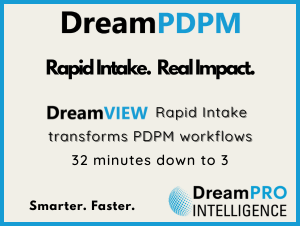
We then show how DreamPRO Intelligence applications—DreamPDPM and DreamVIEW—fit into this workflow to drive measurable financial and quality outcomes. They transform 32 minutes of administrative burden into just 3 minutes of automated precision – rescuing revenue and redeploying clinical staff.
The Reimbursement Plateau in Skilled Nursing
Over the last several years, SNFs have modernized aspects of their revenue cycle, yet many still report stalled or inconsistent gains in Medicare reimbursement. Common root causes include: (1) process variation in admission workflows, (2) documentation gaps that surface at Triple‑Check rather than at admission, and (3) limited time to synthesize referral packets, hospital records, and medications into a complete admission picture. Put simply, the teams are working hard, but the model increasingly rewards working smart—particularly in the earliest phase of the stay.
PDPM: Why the First 72 Hours Matter
The Centers for Medicare & Medicaid Services (CMS) replaced RUG‑IV with PDPM effective October 1, 2019. PDPM classifies each resident into five case‑mix adjusted components—Physical Therapy (PT), Occupational Therapy (OT), Speech‑Language Pathology (SLP), Nursing, and Non‑Therapy Ancillary (NTA)—based on resident characteristics rather than therapy minutes. A variable per‑diem schedule adjusts payment over the course of the stay. Most notably, the NTA component carries a three‑times multiplier for days 1–3, explicitly recognizing the intensity of clinical resources at admission. Accurate, timely identification of NTA comorbidities, medications, and clinical services during this window is therefore essential to fair payment under PDPM.
Data Quality, MDS Accuracy, and Section GG
High‑fidelity MDS coding is the hinge between clinical reality and reimbursement. Section GG, which captures self‑care and mobility items, feeds directly into three of PDPM’s five components (PT, OT, and Nursing). Under‑ or over‑stating function can misclassify residents and suppress reimbursement while also distorting quality signals used by referral partners. Establishing a disciplined Section GG process—clear role ownership, time‑boxed assessments, inter‑rater reliability checks, and early validation—reduces rework and improves both clinical and financial accuracy.
Technology as a Catalyst for Change
SNFs are awash in data at the moment of admission—hospital summaries, medication lists, consultant notes, diagnostic reports, and prior MDS history. Translating these records into the discrete elements required for PDPM classification and care planning is time‑consuming. Emerging AI solutions are proving effective for administrative burden reduction across healthcare by extracting diagnoses, synthesizing histories, and generating draft summaries for clinician review. Early evidence and national deployments indicate material time savings in documentation workflows, enabling clinicians to spend more time on patient care while improving the completeness of the record.
DreamVIEW and DreamPDPM in the PDPM Workflow
DreamVIEW and DreamPDPM from DreamPRO Intelligence operationalize this first‑72‑hour focus. DreamVIEW uses AI to condense admissions packets via the rapid intake process into concise, context‑aware summaries aligned to PDPM, clinical, and admissions perspectives, significantly reducing manual review time from a typical 30 minutes down to just 3 minutes. By surfacing salient elements quickly, the IDT can validate Section GG, confirm primary diagnoses and comorbidities, and ensure high‑cost medications and services are recognized on day one. DreamPDPM enables teams to generate theoretical (prospective) payment estimates at admission and compare them to actual payments, creating a closed‑loop learning system. This gives administrators, clinical and MDS leaders the ability to test assumptions, reconcile gaps early, and memorialize changes during the critical three‑day window and throughout the skilled stay. DreamPDPM with DreamVIEW provides AI-powered efficiency to maximize reimbursement, completing admission assessment in 3 minutes versus industry standard of 32 minutes.
Implementation Roadmap
1) People & Governance.
Form a cross‑functional PDPM Admission Huddle (Admissions, MDS, Nursing, Therapy, Business Office). Assign clear owners for Section GG, comorbidity capture, medication reconciliation, and payer authorization. Define escalation paths for missing documentation on day 1.
2) Standardized Process.
Map the first‑72‑hour workflow, with time targets for receipt of referral packet, initial clinical review, GG observation, and MD orders. Establish a prospective estimate step using DreamPDPM, followed by a same‑day clinical validation step using DreamVIEW.
3) Technology Enablement.
Integrate DreamVIEW into the admissions review process by producing PDPM‑, clinical‑, and admissions‑oriented summaries. Use DreamPDPM to create a defensible estimate on day 1 and track variances against the first 5‑day MDS assessment and final claim. Automate a daily variance report to drive rapid remediation.
4) Measurement & Feedback.
Track Section GG inter‑rater reliability, percentage of complete admission packets at 24 hours, NTA capture rate by day 1, variance between theoretical and actual payments, and downstream quality measures (e.g., readmissions, HAIs, staffing turnover) linked to SNF VBP incentives.
Compliance, Quality, and Risk
Accuracy and defensibility are as important as speed. Prospective estimation must never replace clinical judgment; rather, it should cue focused IDT review and documentation. Embed a light‑weight audit: second‑review of Section GG, medical necessity checks, and validation of NTA‑relevant medications. Align these practices with SNF Value‑Based Purchasing (VBP) priorities such as readmission avoidance and infection prevention to ensure financial improvements track with quality.
Expected Outcomes and Return on Investment (ROI)
Organizations adopting a prospective‑first approach typically report: (1) reduced variance between expected and actual payments; (2) faster, more reliable admission decisions; (3) improved documentation quality; and (4) greater staff satisfaction from spending less time on clerical work. By “getting it right at admission,” facilities position themselves to realize PDPM’s intent—align payment with the resident’s characteristics—while reinforcing quality outcomes rewarded under VBP.
Illustrative Case Study
A regional SNF operator confronted a reimbursement plateau while peers advanced. By moving to a standardized, prospective admission workflow supported by AI‑enabled summarization and early theoretical payment estimation, the operator reversed the trend. The organization memorialized admission decisions, reduced Triple‑Check rework, and created an actionable feedback loop between estimates and final payments. The same practices improved data completeness for Section GG and strengthened referral confidence through consistently accurate, timely decisions. Net results were considerable reimbursement gains that materialized to the bottom line.
Practical Checklist for the First 72 Hours
- Day 0–1: Ingest and summarize referral packet with DreamVIEW; confirm primary diagnosis and comorbidities.
- Day 0–1: Generate DreamPDPM theoretical estimate; identify high‑impact NTA items for verification.
- Day 1–3: Complete GG observations; perform inter‑rater reliability check.
- Day 1–3: Validation of NTA‑relevant conditions and services (e.g., IV meds, diagnoses).
- Day 2–3: Reconcile estimate vs. current documentation; escalate open gaps; memorialize changes.
- Day 3+: Lock in defensible record for the 5‑day assessment; monitor variance through claim submission.
Conclusion
PDPM rewards organizations that execute flawlessly in the earliest days of a resident’s stay. Combining disciplined MDS practices with AI‑assisted review and prospective estimation creates a reliable, repeatable way to capture and maximize reimbursement while improving quality. DreamVIEW accelerates clinical clarity at admission; DreamPDPM closes the loop by translating that clarity into a defensible financial outlook. Together, they help SNFs break through reimbursement plateaus while strengthening the resident experience.
Operational Metrics and Dashboards
To sustain gains, leaders should embed a lightweight analytics layer that translates daily operational signals into action. At minimum, SNFs should monitor: (a) admission packet completeness at 24 hours; (b) Section GG completion and inter‑rater reliability; (c) percent of residents with at least one NTA condition captured by day 1; (d) variance between DreamPDPM estimates and final payments; and (e) case‑mix index (CMI) trend lines for PT, OT, SLP, Nursing, and NTA. These indicators align with the PDPM construct while reinforcing the behaviors that matter most in the first three days. Facilities can display this as a simple daily scorecard visible to admissions, MDS, therapy, and nursing leadership, turning the early‑stay workflow into a disciplined routine.
Change Management Lessons from Early Adopters
Introducing prospective estimation and AI‑assisted summarization is less a technology project than a change initiative. Early adopters report three practical lessons. First, explain the “why” to the whole IDT—PDPM rewards early clarity, and the NTA 3x multiplier for days 1–3 makes accurate identification of complex conditions and pharmacy needs time‑sensitive. Second, keep human review at the center: AI should highlight what deserves attention, not replace clinical judgment or compliance checks. Third, publish small wins weekly (e.g., closed documentation gaps, faster decision times, reduced Triple‑Check findings) to build momentum and sustain adoption.
Limitations and Safeguards When Using AI
While AI can reduce administrative burden and accelerate insight generation, it can also introduce new risks if used without safeguards. Leaders should: (1) ensure summaries clearly indicate they are drafts for clinician review; (2) log source documents linked to each AI‑generated insight to support defensibility; (3) prevent copy‑forward errors by date‑stamping each admission summary; and (4) train staff on privacy and security policies for any tool that handles protected health information. A small governance — group MDS leadership, compliance, and IT—should review AI performance monthly and refine prompts, templates, and workflows as needed.
Copyright © 2025 DreamPRO Intelligence. All rights reserved. Licensed under Creative Commons Attribution-NonCommercial-NoDerivatives 4.0 International (CC BY-NC-ND 4.0).