

The director of nursing services (DNS) and the facility administrator (or other executive leadership) share the overarching goal of providing nursing home residents with the best possible quality of care and quality of life, says Demetrius Kirk, DNPc, MBA, MSN, RN, LNHA, LSSGB, PAC-NE, QCP, a senior consultant with SMK Medical in Detroit, MI. “However, clinical and operational leaders often go down different pathways to try to achieve the same outcomes in support of that goal.”
These differences may make the DNS feel like they are not getting their point across when they are sitting at the table talking with the administrator, points out Kirk, who will present the April 23 session “What Every Administrator Wants Their Nursing Leadership to Know: Mastering CBC” during the April 22 – 25 AAPACN 2025 Conference in Louisville, KY. “The problem often comes down to the fact that you as the clinical leader are not speaking the same language as operational leadership.”
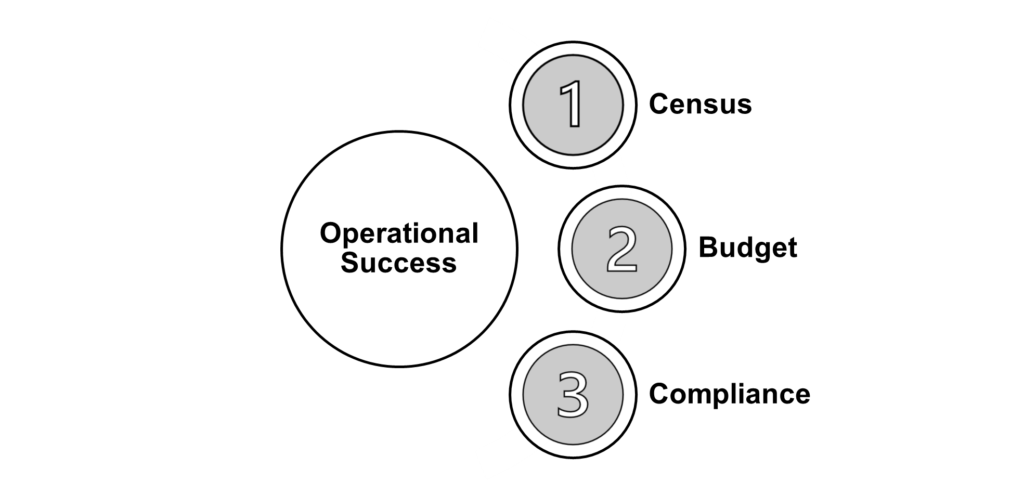
Three factors lay the foundation for effective operations, says Kirk. “These operational drivers are census, budget, and compliance (CBC). In general terms, census fills your beds and keeps the revenue flow steady; budget safeguards financial stability so that you can keep the lights on; and compliance ensures that everything you do is legal and above board, allowing you to keep the doors open. These components are all interconnected and build on each other.”
The following graphic illustrates:
The DNS plays a pivotal role in leveraging CBC to achieve operational success, says Kirk. “Nurses are trained to think from a clinical standpoint. As the DNS, you must know how to get your point across in a way that supports the organization’s mission and, importantly, its financial outcomes.”
The DNS who masters CBC can leverage it to improve clinical outcomes, explains Kirk. “You often can obtain the resources that you need for whatever projects that you want to do—if you can relate those projects to increasing census, improving budget, and/or maintaining compliance.”
How the DNS might request the purchase of a bladder scanner offers an example of CBC’s impact, says Kirk. “If you simply ask your administrator for a bladder scanner, you may be told no or hear the famous words, ‘It’s not in the budget.’ However, if you can approach the administrator with a solution to decrease hospitalizations, reduce urinary tract infections, and improve the facility’s ratings in the Five-Star Quality Rating System, the administrator is more likely to invest in the bladder scanner.”
“The DNS in this scenario has done the research to be able to explicitly link the purchase of the bladder scanner to improving the facility’s census and budget despite the startup costs,” points out Kirk. “As a result of hearing this request in the administrative language of CBC, the administrator will be more apt to buy into the proposal. They have some assurance that the bladder scanner will boost CBC and not just sit in the corner with other machines that staff rarely use.”
Kirk offers the following preview of how his upcoming session will address the DNS’s role from an administrative perspective:
Census: Where it all begins
Census is the starting point for operational excellence, says Kirk. “If you don’t have census, it doesn’t matter how well you manage budget and compliance because eventually your facility will close. So, it’s important for the DNS to see census in a different light—to see it from an administrative perspective.”
Census isn’t the sole responsibility of the facility’s marketing staff, stresses Kirk. “Clinical leadership, as well as admissions staff and the nurse assessment coordinator (NAC), has an important role in attracting and maintaining census.”
To benefit census, the DNS should understand the market (i.e., what the community is asking for), suggests Kirk. “You must have a strong relationship with both your marketing team and your admissions staff for census to function appropriately. This collaboration will help you answer a referral more quickly because you will be better prepared to accept that resident. It also will help ensure that the resident stays in your building once they come in.”
When the DNS doesn’t work closely with marketing and admissions, census can be negatively impacted, says Kirk. “For example, you may respond too slowly and lose referrals because you are unsure if you can meet certain resident needs. Or, you may admit a resident without having their oxygen tank ready or having your floor nurses educated to provide the specialized clinical care that they require, which could result in a transfer to another nursing home or even rehospitalization.”
Budget: Provide appropriate care
To ensure that budget is met, the DNS must prioritize providing the appropriate care to each resident, says Kirk. “Just having ‘a head in the bed’ doesn’t mean that you will meet budget. Appropriate care is critical. For a skilled resident, appropriate care starts with obtaining a skilled admission order that is specific to their skilled therapy and/or skilled nursing needs.”
Appropriate care also includes creating and closely managing a person-centered baseline care plan, says Kirk. “The baseline care plan should address the resident’s immediate care needs, including resident-specific health and safety concerns, and flow into the comprehensive care plan.”
Documentation also is an important part of budget, adds Kirk. “You have to have documentation that supports the fact that you are providing appropriate care that aligns with the resident’s skilled admission order and their baseline and comprehensive care plans.”
Compliance: Bringing everything together to protect the bottom line
Compliance ensures that reimbursement and billing are in full alignment, says Kirk. Keys to compliance include the following:
- MDS coding. “Obviously, accurate MDS coding drives payment for skilled residents,” says Kirk. “However, the NAC can’t bear that responsibility alone. The DNS should coordinate with the NAC to make sure that all team members who participate in MDS coding have the ongoing education and training necessary to code accurately. The DNS also should monitor to ensure that MDS assessments are being opened, completed, and submitted timely—and that assessment reference dates (ARDs) are set to benefit budget.”
- Documentation. In an example of how the elements of CBC cross over and interconnect, documentation is an important part of compliance as well as budget, says Kirk. “The DNS needs to work with the NAC to ensure that team members who provide documentation to support the daily skilled service and/or MDS coding are trained in good documentation practices and are educated on the importance of documentation so that they prioritize meeting daily documentation requirements.
- Adherence to Medicare standards. “The DNS should work with the NAC to ensure that all of the requirements that must be met—from proper coding to proper documentation—are being run through the appropriate reviews during the weekly Medicare utilization review meetings and the monthly triple-check meetings,” says Kirk. “For example, are physician certifications in place so that you can bill appropriately? Is the resident’s primary diagnosis reflective of the actual diagnosis that you are treating them for? These types of questions need to be incorporated into these meetings.”
This AAPACN resource is copyright protected. AAPACN individual members may download or print one copy for use within their facility only. AAPACN facility organizational members have unlimited use only within facilities included in their organizational membership. Violation of AAPACN copyright may result in membership termination and loss of all AAPACN certification credentials. Learn more.